Why Your First AI Hire Should Be You (Not a Prepackaged Service)

Remember when a certain elder-millennial relative (hi) bought a Bowflex, used it twice, and then it became an expensive coat rack?
That’s 2025 AI buying in a nutshell.
We’re drowning in “AI-in-a-box” products promising to make your team smarter, faster, and somehow better at Excel without opening Excel. But if you don’t understand what the tool is doing—or what your team actually needs—then you’re the Bowflex owner hanging blazers on an $1,800 regret.

The contrarian move is simple: before you buy anything, make yourself the first AI hire.
Learn enough to ask better questions, design a few useful workflows, and avoid burning money on “magic.”
Companies with a strategy and internal know-how are the ones that see real performance gains; the rest are collecting SaaS logins like Pokemon cards. (Thomson Reuters)
The Hype Trap: When the Demo Sizzles and the Steak Is Soy
A client—let’s call him “Mike” because his name is Mike—once asked me if a vendor’s “autonomous AI platform” could “do everything.” My answer: “Sure. If ‘everything’ is a synonym for ‘some things, kinda, when the data behaves, and only if Becky remembers the password.’” The vendor demo looked like Star Trek’s LCARS; the implementation looked like Excel with a ring light.

Zoom out from anecdote to data: in 2025, 78% of organizations say they’re using AI in at least one function, up from 72% last year. Progress!
But McKinsey’s own write-up shows a huge catch—most firms are deploying gen-AI faster than they’re redesigning the workflows around it. Translation: we’re bolting a jet engine to a wagon and acting shocked when the wheels come off. (McKinsey & Company)
On top of that, the Thomson Reuters Institute’s latest “Future of Professionals” insight shows lots of buying, not enough planning; the organizations with an actual AI strategy are twice as likely to report revenue growth. That’s not because they bought a fancier model. It’s because they learned what to do before they opened the wallet. (Thomson Reuters)
Your First “AI Team” Is the One You Already Have
Let’s kill a myth: you don’t need a hundred-grand black-box to generate value. You need your people—equipped with the basics of prompting and a couple of well-chosen workflows. I’ve watched non-technical teams cut hours off weekly tasks by learning to articulate what they want in plain language and teaching an LLM to follow suit. No secret sauce—just clear instructions, a bit of structure, and a willingness to iterate.
The companies leading the pack aren’t just buying tools; they’re building capability. Boston Consulting Group’s 2025 research shows only 5% of companies are actually achieving AI value at scale, but the ones that are “future-built” do a few things differently: they re-wire workflows, train their people broadly, and invest in skills, not just software. Agents and agentic systems are part of the mix—but the real edge is organizational learning and governance. (BCG)

UC Berkeley’s California Management Review comes to the same point from another angle: adoption stalls less because of tech and more because of the learning gap—the human side of turning AI from a show-and-tell toy into everyday decision support. You close that gap by experimenting in-house, not by outsourcing your brain. (California Management Review)
Prompting Is the New Power Skill (And It’s Not ‘Coding,’ It’s Communication)
If you survived dial-up tones and AIM away messages, you already get the vibe: the interface has changed, but clarity still wins. Prompting is structured asking. It’s specifying audience, format, facts, constraints, and steps—so the model can reason like a focused intern instead of a caffeinated parrot.
A quick example from an ops lead I coached: every Monday she had to summarize a 60-page weekly metrics pack for execs. We built a single prompt that

(1) defined the audience,
(2) named the five KPIs that matter,
(3) forced a “What changed vs. last week?” delta view, and
(4) required a 3-bullet “Do next” section tagged by owner.
Ten minutes replaced two hours.
Once she saw that, she didn’t need a vendor to “productize” it—she needed a repeatable SOP with a quality checklist. Now that she could scale.
McKinsey’s 2025 materials say the quiet part out loud: real value shows up when companies redesign work—roles, rituals, and review cycles—to match what AI can actually do. Prompting is the hinge. When people learn it, they stop buying tools to write emails and start re-imagining how emails get decided. (McKinsey & Company)
Learn First, Then Buy: The Money Case (Not Just the Morals)
I love a good “invest in your people” speech, but here’s the CFO-friendly cut: learning first is cheaper—and it compounds. Menlo Ventures’ 2025 consumer AI study found people want control over how they use AI, not just outcomes. That preference maps to buyers, too: if your team understands the work and the workflow, you purchase only what fits—no bloat, fewer shelfware logins. (Menlo Ventures)
Layer in sector specifics and the math gets crisper. In healthcare, for instance, Menlo + Morning Consult show execs are pushing deployment, but the value skews toward orgs that match use-cases to data reality and workforce training. The lesson for any industry: shared context + internal capability reduces waste and de-risks implementation. (Menlo Ventures)
BCG’s numbers reinforce the stakes: 60% of companies see little to no AI benefit, and only 5% are realizing value at scale. The common thread among winners is not “more AI,” it’s better integration and upskilling—think re-imagined processes, consistent governance, and wide employee training, not a couple of “AI champions” waving pom-poms. (media-publications.bcg.com)
So yes, training takes time. But so does chasing refunds for tools you never adopted.
A Practical Starter Playbook (AKA: Be Your Own AI Hire for 30 Days)
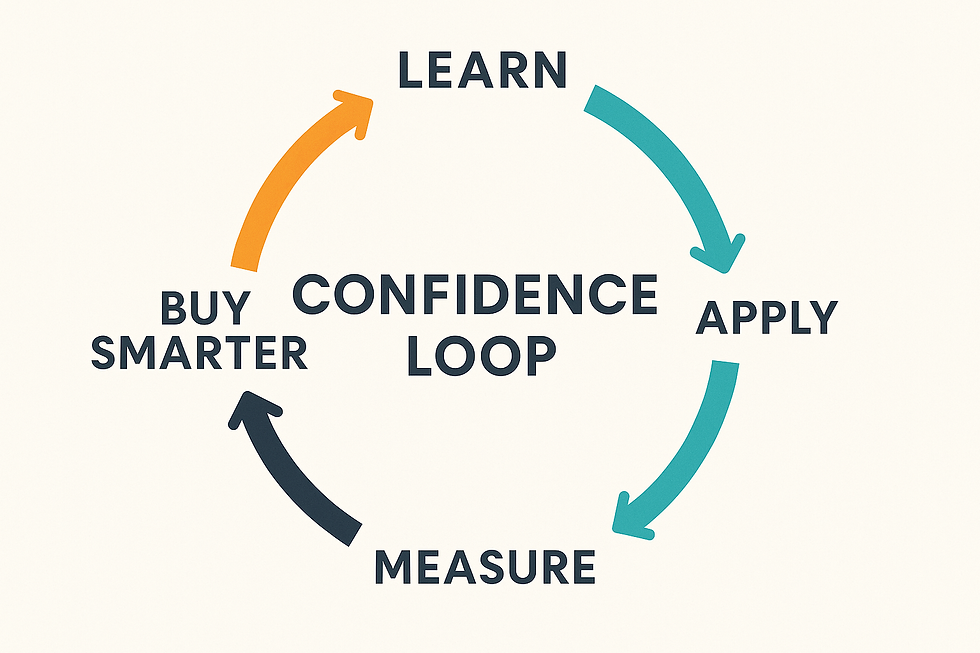
Enough pep talk—here’s the plan that turns curiosity into capability without melting your calendar:
Pick one nagging workflow per function.Sales: proposal drafts. Ops: meeting minutes → tasks. Finance: variance narratives. HR: first-pass job descriptions. Marketing: research → outline → first draft. (One per function is plenty. You’re not rebuilding the Death Star.)
Write a “house prompt” for each.Use a 5-part skeleton: Context → Goal → Inputs → Output spec → Guardrails. Save it in a shared doc. Treat it like a living SOP, not a tattoo.
Create a 10-minute daily ritual.Everyone who uses the prompt leaves two notes: (a) what worked, (b) what went weird. This is your micro-R&D loop.
Add a human checkpoint.Who signs off? What must be verified? What data sources are “allowed”? Basic governance beats hero culture.
After two weeks, instrument it.Track time saved, error rates, and “time-to-usable-draft” vs. baseline. You don’t need a PhD—just a before/after and a trendline.
Only then shop for tools.Now that you know the job to be done, evaluate vendors against your workflow, not their feature dumps. Ask for proofs on your data. (And if a rep says “trust the AI,” smile, nod, and exit stage left.)
This is boring on purpose. The goal is to build judgment. The companies that win treat AI like a new capability, not a vending machine.
Why Community Beats Lone-Wolf Mode (and Where to Find One)
Here’s something the reports don’t quantify well: confidence spreads socially. People move faster when they can compare notes, borrow prompts, and see what “good” looks like. The Reuters Institute’s 2025 research on public AI awareness shows familiarity correlates with willingness to engage; the same curve lives inside companies—exposure reduces hesitation and speeds adoption. Put simply: your team learns faster together than alone. (Reuters Institute)
That’s why I nudge folks to join a practical AI community—not a hype circus. Bring a workflow, leave with a better one. Ask dumb questions (they’re not). Share your wins and faceplants. If you want a place to do exactly that, join our community to interact, learn, and grow with other AI users. You’ll get real-world prompts, peer feedback, and weekly teardown sessions that turn “we should try AI” into “we shipped three AI-assisted workflows this month.”
Bottom Line (AKA: The Part You Screenshot)
Buying AI before you understand it is like paying surge pricing for an Uber… to walkable distance. Learn the basics. Ship one tiny win per function. Then—and only then—open the checkbook.
Because in 2025, the highest-ROI “AI hire” in your org isn’t a tool, a vendor, or a silver bullet.It’s you.
Works Cited (2025)
Boston Consulting Group. “Are You Generating Value from AI? The Widening Gap.” BCG, 30 Sept. 2025. Accessed 30 Sept. 2025. (BCG)
Boston Consulting Group. “The Widening AI Value Gap.” BCG, Sept. 2025 (PDF). Accessed 30 Sept. 2025. (media-publications.bcg.com)
Chopra, Ankit. “Adoption of AI and Agentic Systems: Value, Challenges, and Pathways.” California Management Review (UC Berkeley), 15 Aug. 2025. (Article + PDF). (California Management Review)
McKinsey & Company. “The State of AI: Global Survey.” 12 Mar. 2025. (Overview + full PDF). (McKinsey & Company)
Menlo Ventures. “2025: The State of Consumer AI.” 26 Jun. 2025. (Menlo Ventures)
Menlo Ventures. “2025: The State of AI in Healthcare.” Oct. 2025. (Menlo Ventures)
Reuters Institute for the Study of Journalism (University of Oxford). “Generative AI and News Report 2025: How People Think about AI’s Role.” 7 Oct. 2025. (Reuters Institute)
Thomson Reuters Institute. “The Data Speaks: What Has Changed in AI Adoption Trends This Year.” 28 Aug. 2025. (Thomson Reuters)


https://soicaulodechuan.mobi/giai-ma-so-hoc cái mình thấy tiện là bài có sẵn mục lục, không phải vừa kéo vừa đoán đoạn cần đọc nằm đâu. Mình hay tranh thủ xem vài phút thôi nên gặp bài nhiều chữ là hơi ngại, có chia đầu mục rõ ràng thế này thì đỡ hơn hẳn. Đọc lướt phần đầu cũng hình dung được cách bài sắp xếp, chứ không bị cảm giác một mạch toàn chữ với số. Mình chưa nói tới chuyện nhận định đúng sai nhé, chỉ thấy cách trình bày khá dễ theo dõi. Có lúc mình chỉ muốn xem lại kết quả hôm trước, không muốn đọc hết các phần khác. Bảng kết quả xổ số miền Bắc ngày hôm qua…
kèo nhà cái mình thấy bạn bè nhắc suốt nên cũng bấm vào nghía thử cho biết. Mình không đọc kỹ nội dung đâu, chỉ lướt qua xem trang họ làm có dễ nhìn không. Ấn tượng ban đầu là giao diện khá sáng sủa, khoảng cách giữa các phần vừa đủ nên kéo xuống không bị rối. Mấy khối thông tin được chia tách rõ ràng, nhìn cái là biết đang ở đoạn nào chứ không bị dính chùm vào nhau. Mình cũng để ý thanh menu đặt ngay chỗ dễ thấy nên đổi qua lại mấy mục khá nhanh, không phải mò mẫm. Nói chung kiểu trình bày gọn gàng, nhất là cách họ để menu điều hướng…
Bài viết dễ hiểu, có ví dụ thực tế khá sát nên đọc vào thấy thấm, cảm ơn bạn đã chia sẻ. Dạo này mình cũng hay để ý mấy nền tảng giải trí trực tuyến, chủ yếu xem họ chia chuyên mục và bố cục hiển thị cho người dùng chứ không đi sâu từng trò. Mình gom lại vài chỗ hay xem để tiện tra lại, ai quan tâm thì ghé thử https://www.openrec.tv/user/Soicauxsmbpro/about